Showing posts with label Bottomlands. Show all posts

Thursday, April 2, 2026

My Environmental Manifesto

I’m sitting in a grove of thorny, low growing bushes called prickly ash.  The name belies their origin because they truly are nowhere near any rendition of an ash, other than the compound leaf that most likely gave it its name.  Besides, the ash we know has been wiped out now for nearly two decades, although I walked through a marshy cathedral of their remnant trunks on my way into this grove.  They are the aftermath of an invasive species gone unchecked.  And while I do know of a micropopulation of decent aged green ash that are growing at the base of a ridge just beyond the banks of a clear flowing trout stream in Northern Michigan–hemmed in by a cedar and tamarack swamp–not many ash trees still exist.  With each species loss in a specific ecosystem, the diversity of our environment takes a substantial hit.  My prayer is that like the chestnut of yesteryear, the green ash too may find a way to rise from charred ashes as the storied phoenix bird–to grow again in our forests.  It’s a mythical story lined with hope for something different.  It’s hope that can provide fuel, especially at a time when diversity is served at a minimum and draws hisses from the forked tongues of those who claim to preach grace, mercy, and acceptance.  Diversity is the building block of our earth.  Just look around!  Do they wish to live in a world of box elders without oaks, pines, hickory, and firs?  It appears their aim against diversity is a bullseye for those who may believe differently from what they’ve deemed suitable.

Did they miss school on the day their 5th grade science teacher taught the basic fundamental principles of ecology–fondly referred to as life science?  They must have zoned out when symbiotic relationships were discussed in combination to how all things are connected.  You need carnivores and herbivores alongside the omnivores, scavengers, decomposers, parasites, and hosts; plant, predator, and prey.  And while I love a good grove of scrubby scotch pine, as they have their purpose as a pioneer plant, my eyes light up when a white pine takes hold.  In short order its soft needled branches will help bring shade and coolness to the sun scorched sands its roots hold onto–leading the land towards the next stage in the succession of life and a climax community.

The idea of a sentinel white pine staking claim in the midst of fast growing, short lived, pioneer plants reminds me of new houses lining a beautiful blue lake with every centurion tree reduced to irrigated blue grass.  What of the one lake house holding on and not competing with the Jones’; hidden amongst the remnant oaks and hickories that once lined the shoreline and forests beyond?  Neighbors look on with spite at the leaves, acorns, and nuts that are seasonally dropped, while the owners revel at the cool breezes, wildlife, and natural shade–looking out past the docks at the dimpled water. One side seems sterile while the other does its best to blend.

And so I sit amongst the prickly ash.  I’d love to have a small plot of them in my own yard.  The roots send up new sprouts into available light, and their sharp thorned branches intertwine.  I am also at the base of massive oaks–of the diversified red, white, swamp, and burr.  These oaks anchor a point surrounded by the inside bend of a river, intermixed with trees such as hackberry, cherry, cottonwood, black walnut, shagbark hickory, and silver maple–in addition to low growing shrubs of gray and red osier dogwood, gooseberry, and button bush.  Each is a necessary and valuable detail of a bigger picture.  Each is a piece of our ecosystem’s puzzle.  Each is included in a melting pot for what we label as the forest.

For indeed, without the inclusion of a vast array of species, we are left with a plantation born of a monoculture.  Have you seen the aerial shots of forests planted with one species after a devastating disease or invasive insect sweeps through?  You end up with geometric shaped dead zones within property boundaries; brown year-round until they rot back into Mother Earth.  Or how about black and white pictures of quaint towns and cities shaded under massive, iron strength American Elms?  Once upon a time now passed, it was like driving through a wooded tunnel.  Orioles, in their hanging soft-weaved bassinets, raised their babies high above the streets.  That was before the disease killed off our American Elms in the 1960’s and 1970’s.  I still see lone elms growing occasionally in out-of-the-way places, for their shape is unique and distinct, but their age seems limited with an expiration date.

With the elms gone, city planners planted the green ash.  When those disappeared, they looked around in wide-eyed wonder.  Cities were left treeless due to their lack of diversification.  But since a generation of leadership had come and gone, we forgot to learn from those who lived and saw what happened before us.  Perhaps humans are more cyclical than we give them credit–but not always in a good way–making the same type of decisions while expecting different results.  They say that’s the definition of insanity.

Equity.  Each species needs the chance to grow and live unencumbered.  Nature finds a way, and can somehow heal, but it takes time; so much time–espcially after human interference.  It’s the kind of time that simply won’t make a whole lot of difference in some areas–developed to death and destruction without the opportunity to live in conjunction with humans; irrevocable as opposed to in harmony.  And in the places where various species of trees are allowed to come back–back to a point where we can look at them in awe, and wonder at their history as a hub tree–a Grandmother Tree–our time will have expired and we’ll have missed their resurrection.

Will it be enough to have set aside areas for future generations?  Imagine areas that are small like natural backyard gardens and neighborhood parks of native prairies, forests, rock, or desert flora next to playground equipment and athletic fields.  Imagine areas for future generations that are beyond our comprehension–lined with countless lakes, sprawling swamps, and extending mountain ranges.  We find ourselves now on a precipice of decision making; decisions made by those deemed responsible by a majority vote and quest for power and resources.  Somewhere in the mix of pick-up-sticks, that is chaos and despair, I hope.

Westward expansion, even then at a great expense, no longer exists.  The millions of First Nation people past and present could tell you stories.  It wasn’t a blank slate without a cost.  We now know the ends of the Earth.  So what is left that greedy eyes hope to conquer and consume?  The legacy of our values and decisions becomes the heritage our bloodline will receive.

While I wonder at the diversity of species, equity of lands preserved, and the inclusion of environments allowed to work together, I have to also wonder about the Earth itself.  Will resources always take precedence so nothing is sacred?  Will nothing be set aside and left untouched?  If I look at how land and water have been treated, both here at home and abroad, I gasp.  Natural resources the world over have been treated as a commodity.  And when it's gone and destroyed beyond recognition, it’s deemed “not my problem” and shelved as a historical archive.  It makes you wonder if people truly believe that “might makes right”.  It’s not how I was raised.  It’s not how I was taught to treat people or the earth.  It’s not how I spent 35 years teaching students.  It’s not how my wife and I raised our own kids.

Shouldn’t the core of how we interact be the attributes of respect and responsibility regardless of our differences?  It’s been my badge and personal mantra–both for our Earth’s creation, as well as for our fellow global neighbor.

Today in the forest surrounding me I’ve been serenaded by chickadees, nuthatches, blue jays, canadian geese, sandhill cranes heading north but confused by winter’s fake spring, barred owls on the tail-end of their mating season, pileated, flicker, and downy woodpeckers, mallards, and ironically the cries of the bald eagle; our nation’s symbol.  Those are the diversified feathered species I am familiar with and can identify.  There are so many I don’t yet recognize.  I could stay ignorant and call these surrounding members of nature the generalized label of trees and birds one is apt to do–by someone who lacks a deeper understanding–but I choose understanding, while knowing it’s an ongoing process.  I choose the fairness of opportunity to include all the pieces of the environmental puzzle–to live and let live.

That’s not to say I don’t fish, hunt, or gather; but only within personal boundaries.  If I take, I give back.  I believe the buzz word for that is reciprocity.  I like the relationship it takes to build such a thing.  With my students and my own children I used to say, “If you kill it, you need to eat it.  If you don’t want to eat it, then don’t kill it.”  That goes for northern pike, gray squirrels, or a spider you find in the corner of your living room.  Would you say that’s a philosophy that highlights respect?  Would you say that’s a philosophy that recognizes that everything has a purpose?  I feel that it’s an important aspect to bring up, because the sheer number of people and their monies that are invested in hunting, for instance, can help purchase and maintain public lands and their restoration–if those funds and their directive are used for good and not evil by the entrusted governing body and the ensuing policies under that governing body’s leadership.

“Nobility is not a birthright” was a line used in the 1991 film, Robin Hood: Prince Of Thieves.  It was spoken by the protagonist Robin of Locksley.  It reminds me that leadership should never be followed simply because of a person’s flex of power.  If I am to personally listen to or be guided under one’s leadership–respect will have to be earned.  How does their integrity stand up to time and pressure?  How do they act?  What do they say when they speak?  How do they treat others?  Do others follow out of desire, or out of fear?  Does the leadership at hand work to be a voice of the people they represent or fall under the agencies at play around them–those who have the most money and sway?  What happens to those who deviate ever so slightly from the leadership's beliefs–including those who helped them get into that position?  Will the leadership forge ahead and do their own thing regardless of wise counsel?

Who else will speak for the trees?  Who else will reserve the land and treat it with respect if the community at large doesn’t step up to the plate?  I also used to teach my students that whatever we do to the land we do to the water, and whatever we do to the water we do to the land.  They are inseparable.  They work as one.  Nature as our teacher.

Although both are non-living entities, soil and water–in conjunction with sunlight, air, and rock–are the very ingredients that allow for the living here on Earth.  To say non-living aspects aren’t important or necessary is similar to yanking the table cloth out from under a set of your Grandma’s finest china; something in the realm of the living is going to come crashing down.  You can’t have the living without the non-living.  You can’t influence the land without affecting the water and visa-versa.  Thankfully, with an environmental mindset, the hope is that the land and water can also help heal each other–if just given half a chance.  As Rick Bass stated in With Every Great Breath, “Nothing exists long without the support of another thing.” (277)

What are the logistics behind the hope for a healed Earth; a better Earth?  What is the next step?  Do we wait until the water at our kitchen tap is making us sick?  Do we wait until the air in our community’s AQI rating is over 300?  Can we save the wood plot a few roads over?  Can we prevent an entire field from being covered in solar panels and direct the powers that be to instead use the large rooftops of existing corporate buildings?

I love the idea of preventing urban sprawl by carving wilderness from previously developed spaces; now in disarray and in need of a healing hand willing to lend tender love and care.  Tearing down, fixing up, or repurposing spares the wild while bringing community pride and a fresh hope to areas otherwise forgotten.  If I was that space, it’s how I’d want to be treated.  Just give me a chance–I’d say–and I’ll show you what I can do!

I also love the wild; plain and simple.  Some are afraid of it and do all they can in their power to tame it and to subdue it; squelch it.  Yet there are so many facets and spider webbed aspects of the wild.  The wild out there is the wild within.  Do we not realize that by destroying the diversity of the wild and its inclusion of living and non-living components destroys us?  The wild’s inclusion of all things–the living, once living, and non-living components–is what brings equity to all within an ecosystem’s limits.  And I’m not sure there really are any distinct limits–margins maybe–but the areas between ecosystems mesh like a zipper even in those zones.  Granted, there are ebbs and flows–flucuations in the populations–but that’s the way a system works.  It’s why each entity belongs.

Certain members of society would say the demise of the world is a sign of the end times and clap together in apocalyptic glee while celebrating that something better is offered beyond this life; following Armageddon.  And while I wouldn’t argue against any sense of restorative hope, I also call bullshit.  "What about now?”  What about the present?  I believe the quote people use for such a circumstance is, “Are you going to fiddle while Rome burns?”–with a no-care attitude.  I learned at a young age to take care of my toys.  Personally I feel as if we should show respect while taking care of this creation we’ve been given–that we’re a part of–that we are guests of while here.

To take a step forward we need hope.  It’s what moves us forward; mentally, physically, spiritually–individually, nationally, globally.  Each of us has a unique talent based on our gifts, our available resources, and our locale.  What is your niche?  What is your super power to help?  Do you have talents as a civic planner, teacher, grant writer, engineer, construction worker, real estate agent, leader, public advocate, surveyor, advertiser, organizer, fund raiser, or even a rah-rah person?  You always need someone to cheer from your corner!  I like Brene’ Brown’s spunk when she states in Braving The Wilderness, “Imagine an organization where a critical mass of people are leading and innovating from a wild heart, rather than following suit, bunkering up, and being safe.  We need a wild heart revolution more than ever.” (162)  Amen sister!  We can’t do it all. And we often are already stretched thin.  So sometimes we start small to learn the facts and recognize what’s going on around us.  Sometimes we must start small–have to start small–to avoid burnout and despair.

In her book Braiding Sweetgrass, Dr. Robin Wall Kimmerer states:

“Despair is paralysis.  It robs us of agency.  It blinds us to our own power of the earth.  Environmental despair is a poison… But how can we submit to despair while the land is saying “Help”?  Restoration is a powerful antidote to despair.  Restoration offers concrete means by which humans can once again enter into positive, creative relationship with the more-than-human world, meeting responsibilities that are simultaneously material and spiritual.  It’s not enough to grieve.  It’s not enough to just stop doing bad things.

We have enjoyed the feast generously laid out for us by Mother Earth, but now the plates are empty and the dining room is a mess.  It’s time we started doing the dishes in Mother Earth’s kitchen.  Doing dishes has gotten a bad rap, but everyone who migrates to the kitchen after a meal knows that that’s where the laughter happens, the good conversations, the friendships.  Doing dishes, like doing restoration, forms relationships.” (328)

These things I’ve pondered today.  While sitting in a grove-like thicket of prickly ash, at the base of a white oak, and a stone’s throw from a flowing river, I’ve wrestled, debated, and thought about the ideas swirling around our world.  I’ve also cooked a meal, sat still, and observed–but I’ve also pondered.  In some ways these ideas are nothing new, but with the limitations of space and growth of selfishness, our environment and world yearns for healing while exercising the Diversity, Equity, and Inclusion of the species and systems that have been churning along on Mother Earth for quite some time.

See you along The Way…

Wednesday, December 31, 2025

A Couple Of Friends

It was the winter solstice of 2025.  It was brisk.  It was cloudless. It was a day of blue skies.  It was also a day with good friends.  I’ve known Scott and Justin seemingly forever.  They’re now both principals in their respective schools, but before that we taught together in the Prairie Hill School District.  Scott joined the staff in 2002 and Justin in 2011.  By that time I had a decade or two under my belt.

Over the years we’ve traipsed together through snow and over ice.  We’ve marched in swampy muck.  We’ve paddled down snaking rivers and across ripple surfaced lakes.  We’ve run together on black topped paths, along wooded trails, and in various races and marathons.  We’ve fished and we’ve cooked meals over a small open fire in remote areas.  In other words, I’m not sure I could come up with a sound number for the amount of times that the three of us have gotten together or headed out on an adventure.  It’s been a healthy plethora!

But it had been a while since our last get-together, so it made sense to reassemble over Winter Break.  Beyond “when” we went, “where” we went, and “what” we did, I found that it was more about “how” the trip transpired.  While enjoying the company, I found myself analyzing our time and the way we were interacting.  It wasn’t a formal case study or anything like that.  It bordered more on an out-of-body reflection.  We talked of course.  Each of us inadvertently shared what had been going on in our lives since the last time—all while we drove and hiked.

Once we had arrived at our familiar destination, deep in the woods and along moving water, we each went to work.  I found our efforts both interesting as well as refreshing.  When the time comes that I can no longer do such things, or am scattered to the four winds, they’ll easily know what to do to carry on with another generation of friends.  They don’t know all of my secret spots, but they know enough of them, and that’s all that really matters.

We set about finding dead wood, small twigs, and dried grass as tinder.  We did that automatically with hardly a word.  After we had brought our offerings to the river bank, we coaxed the fire into existence and cooked our food.  During the process there were times when it was actually quiet.  It wasn’t awkward. It felt natural.  We knew how this was all going to play out, so it didn’t need anything additional.  It simply felt good to mumble a few things and then stare into the flames while we waited for the food to finish cooking.  And while that was happening we each did a task that needed to be done.  It happened intrinsically because we’ve done this a hundred times together.  We know the next step is going to either be stirring ingredients, adding salt and pepper, putting some sticks on the fire, leveling the frying pan, or nestling the pot of water closer to the coals.  While eating, we remembered other such times when we had done this very same type of thing with funny or unusual sidebar events that happened simultaneously.

In the end we hiked and we ate.  But through it all we also did what simply needed to be done while enjoying the process of being together.  Friendships look different depending on a host of variables.  For Scott, Justin, and me it started a long time ago in a school building where as staff members we weren’t just colleagues, we became friends that shared common interests.  It’s the kind of situation that not only makes a staff stronger, it allows friendships to transcend time.  I suppose the connection that the three of us have is unique and a little out of the ordinary when it comes to the activities that bring us together, but it works, and we enjoy it.

See you along The Way…

And A Few Random Pictures From The Past:

Justin, Scott, & Me - Winter Of 2012 Or 2013
Paddling The Sugar River - Fall 2023

At My Daughter's Wedding - Winter 2023
Fishing The Kishwaukee River - Summer 2025

Thursday, March 28, 2024

A Perfectly Miserable Day

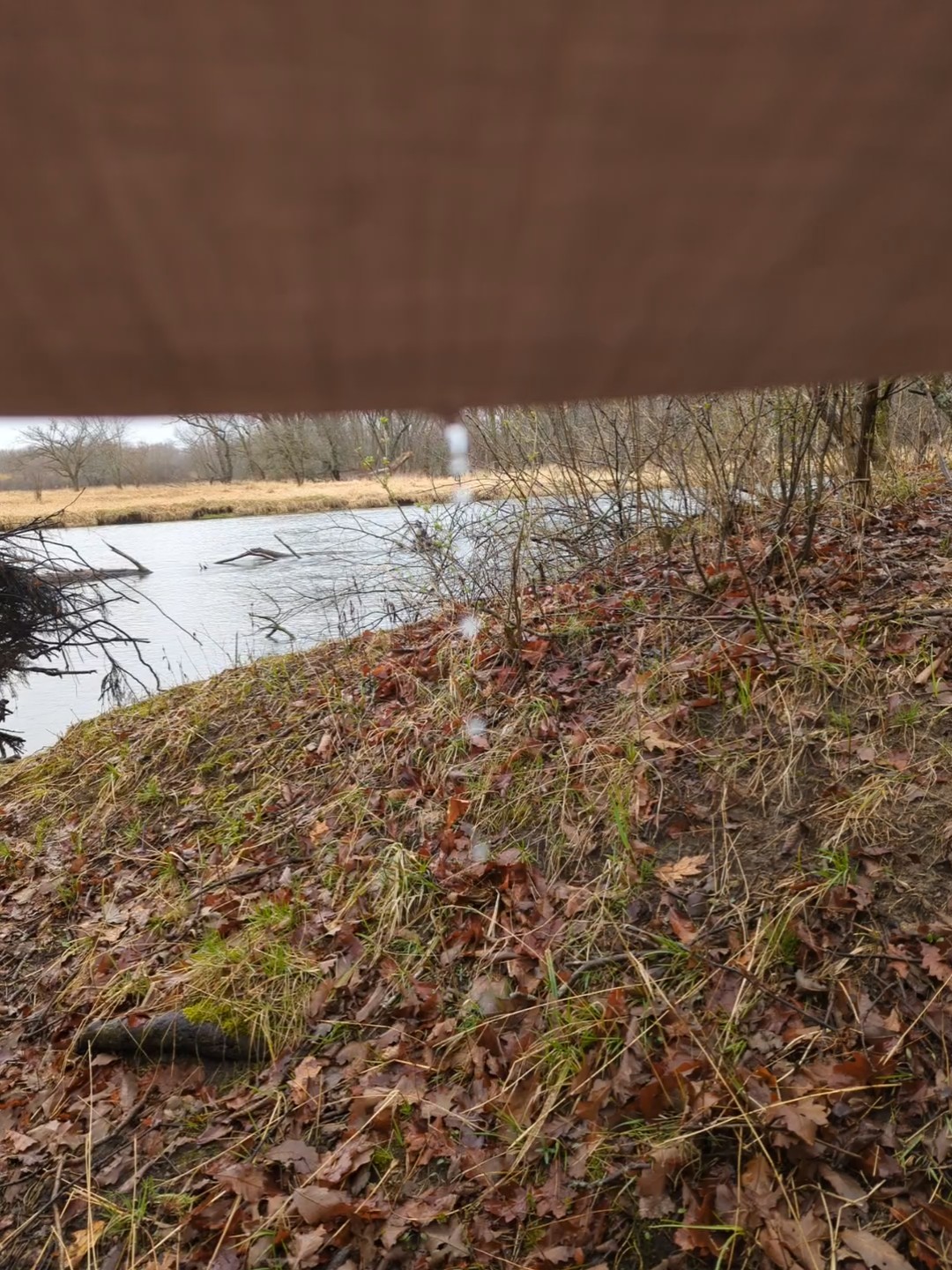
It’s Spring Break at our school this week.  So far it’s miserable weather.  It was a perfect time, however, for our dog Kora and I to head to the woods along moving water.  We hiked during an outright downpour through the woods until we met the river’s edge.  While doing so, we spooked out a barred owl from a low hanging tree limb just a mere 10 feet in front of us.  I hadn’t noticed him until he flew, as he must have held off for as long as possible to avoid flying in the rain.

I had thought of hiking into a different area, but the last time that I took Kora out she could hardly move for the next two days.  So this time I chose a shorter route that was still worth the effort.  We shared the food that I cooked over the small camp stove.  Typically I like to use a small open fire, but I wanted to go stealthy this time, plus everything in the woods is absolutely soaked right now.  Sledging in dry firewood seemed unnecessary, so I pulled out the little stove instead and it worked perfectly.

Kora’s tucked in beside me now on the quilted blanket I put down over the damp ground.  I pulled a corner of it around and on top of her because she was shaking after getting soaked.  She’s warming up now though, and actively watching and sniffing everything around us.  She’s my eyes while I journal.
CLICK BELOW FOR A VIDEO OF
ME JOURNALING AT THE RIVER'S EDGE:

Perhaps the soreness she had felt after last week’s hike was due to the terrain, and the fact that we haven’t been out for a while, although that’s never stopped her before - ever.  Perhaps it was because she’s getting a little older (she’s almost 10 years old), but she’s the picture of consistency when it comes to “getting out of Dodge” and going on an adventure.  Maybe it was due to the Lyme Disease she had as a puppy; now affecting her joints all of these years later.  I’m secretly hoping that this is not the cause, because otherwise, it could be like looking in a mirror.

I myself was just diagnosed last week with Lyme Disease.  Who knows when or where I got it.  The “how” comes from the deer tick, but I don’t really recall when I’ve had one on me; apparently I have though.  Kora had to have a series of treatments to deal with the effects of the disease.  I’m not sure what the ramifications of the disease will be for me.  It was only a week and a half ago when my wrist, ankles, knees, and shoulders began to ache and swell.  I went to the doctor a few days later for some blood work and now it’s a waiting game to see when I can get into a rheumatologist to figure it out.  No wonder it felt like I was slogging through mud when I had tried running two days in a row last weekend.  All I know at this point is that I, “didn’t get it recently”; which I’m taking to mean that I’ve apparently had it for a while.  These are some of the things I’m mulling around in my brain and thinking about while out in the woods today.

In the meantime, a mallard duck flew low along the river’s surface a while back and an eagle flew with the currents of air out over the opposite bank.  Two woods ducks cruised in squawking their “oo-week” call on the bend of the river just down from me.  I’m not sure where they went, but if they swam upstream next to Kora and me, they had no idea we were here hidden up on this bank.  The air is starting to get cooler as they predicted, and the breeze is picking up now that the rain has stopped.  It’s gearing up to reach 20+ miles per hour by this afternoon.  I rather liked the sound of the drops on the tarp I had strung up to protect us, but the wind traveling through the treetops is just as comforting.  Cardinals are calling from the large oaks around me while flickers and kingfishers announce their presence nearby.  Sandhill cranes rattle their sound as gray clouds race away to the east-northeast.  It’s what I guess Winnie The Pooh would call a “blustery day.”

I probably had some other chores to do this morning and I know I had some paperwork.  But I’ll vacuum, sweep, and get a couple loads of laundry in once I get home and dry; so that will at least be something.  I’ll need to get after those other things soon, but after the schedule I’ve had the last few months, I needed to get outside to reset.  Smelling damp, decaying leaves, seeing high moving water after almost 24 hours of heavy rain, and listening to the train engine roar of the wind through the rattling branches is well worth the cold beginning to sink into my hands and creep down through the layers into my inner core.

This outing will be the fuel to spur me forward as I finish out this school year.  A host of things have already been accomplished since last fall, but I still have some other things to rock out between now and this spring.

Virginia Bluebells Beginning To Emerge

A few weeks ago I had thought of canoeing and camping as I’ve done the last couple of years over Spring Break, but the weather this year would have been “tough sledding” - quite literally those first couple of days when we were covered with a layer of snow.  As it turned out, this outing is just what Kora and I needed.  Hiking in and setting up a base camp was doable and necessary for a day like today, and yet not so much work that when the time comes to pack it up that I can easily get it all down, onto my back, and trudge it in my pack to the old Silver Jeep.

To anyone else, today is a terrible day.  The skies are dark, the woods are drab of color, and the weather is gloomy.  It’s the kind of day that guarantees that you’ll have the forest and riverside all to yourself.  It’s what makes it a perfectly miserable day.

See you along The Way…

Kora - My Partner For Adventures!

Saturday, June 17, 2023

Unexpected Friends


It wasn’t your typical Spring Break trip; in that it wasn’t somewhere far away, with other family members, or located within walking distance of a beach.  Heck, it really wasn’t typical in any fashion or form, which is why it was perfect for me and helped to fill the void of wanting to do something adventurous over the couple of days that I had off from teaching.  Although I have enjoyed a warm weather getaway a time or two in the past, it would not be this year with future travels already planned for graduations in different parts of the country later that spring.  And so it was, that despite freezing cold temperatures predicted throughout the night, I decided to take to a wild river, in a relatively close vicinity, for an overnight camp out.

I gathered and prepared my gear without too much of an issue.  And although getting the hefty canoe up on top of my Jeep was difficult without any help, I didn’t strain any tendons or pull any muscles, so I counted that as a success.  At one point, however, while strapping down the Starcraft to my rooftop, I forgot that the darn thing hung down low on each end of the vehicle.  After attaching the hook for one of the cam buckle straps, I walked around the back end of the Jeep so I could tighten down the canoe and secure it from the other side.  Unfortunately I was looking down at another hook that I needed to attach to the trailer hitch and didn’t see the stern that was level with my noggin and ran headlong into it!  It rang my bell and hurt like the dickens of course, but I remained eerily calm about it until I went inside to explain to my wife Cindy what I had done.  Then I lost it for a few unsavory moments within the confines of my house.  Once the initial pain had somewhat subsided, and I had regained my wits about me, I finished my preparations; all the while silently scoffing at myself for the self inflicted blunder.

Cindy and I then took off towards the drop off point under sunny skies in the late afternoon.  I would have just enough time to paddle down the river and set up my camp before the sun set.  Upon our arrival at the launch, and with a quick goodbye, I shoved off with my gear piled high.

CLICK BELOW FOR A VIDEO OF
PADDLING ON THE RIVER:

To watch the video you may need to change the "view version"
at the bottom of the page.

Several hours later I pulled alongside the inside bank of a sharp bend.  There was little to no gradual incline of sand to run up upon due to the high water of the snow melt, so I found a cut in the shore where I could wedge the bow.  It was there that I unloaded the supplies and found a suitable site nestled back in under the bare branched trees of the surrounding forest.  I tried to work smart and efficiently because I could see my time was limited before darkness fell.

The Setting Sun Behind My Camp.

With the tent set-up I threw in my sleeping bags and wool blanket; other various items I stored under the fly of my tent.  Using some of my remaining energy, I dragged my canoe back into the woods using a semi-worn deer trail that ran just beyond the footprint of my camp.  Already my hands were getting cold and I periodically stopped to warm them after adding additional layers of clothing.

The Rising Moon.

Dinner was a brat and baked beans washed down with some hot chocolate.  The food was as welcoming as the warmth of the small fire while the last rays of the setting sun were replaced by its reflection off the rising moon.  The stars, in vivid clarity, were absolutely spectacular.  The distinction of “Orion the Hunter” was unlike anything I had ever seen.  Without a hint of light pollution, other than the surrounding celestial bodies, I could identify each of the key components of this well known constellation.  Typically people can locate Orion’s Belt, but to be able to clearly see each star that creates his outline and instruments for hunting, was downright memorable.  With that image burned into my mind, I cleaned off my dishes in the river, snuffed out the dying embers of the fire, and got ready for bed.

Planets To The West.

The Moon And The Stars.
Can You Locate All Of Orion The Hunter?

Since cold air sinks to the lowest elevation, and I was camped along the river’s edge, the temperatures dropped down into the high teens that evening.  With nothing more than a well ventilated nylon tent for my shelter, I doubled my two sleeping bags (one inside the other), wrapped them in a wool blanket, and laid it on top of a sleeping pad.  I myself wore wool socks and my running tights under a pair of flannel pants.  My upper body was insulated with a T-shirt, long sleeve shirt, and a hoodie sweatshirt.  The ensemble was completed wearing a stocking hat with my hoodie pulled up and over that to prevent any cold drafts down my back.  Despite having to bundle up, I slept soundly once my feet were warm, and only slightly stirred to the several times that I was serenaded by barred owls and coyotes off in the distance.

The following morning was cold!  It was hard to do anything for any length of time before I had to put something back on my hands and try to warm them up.  That limited my dexterity!  I cooked breakfast over a little burner stove that my Dad had given me a year or so ago.  The skillet I made consisted of my final brat, two small potatoes, and a couple of eggs.  It was just enough.  My tent was covered in a thin layer of frost; the result of frozen condensation, but I went ahead and packed it away knowing that I’d have to dry out my gear later that afternoon.  I ruffled the leaves and scattered some sticks to erase any signs of my camp.

Erasing The Footprint From My Tent.
Snow Was Still Evident Around
The Base Of Trees.

It was about that time that I saw a pair of pileated woodpeckers.  This species of bird is huge as woodpeckers go, and about the size of a crow, although they look more like a pterodactyl.  One of them flew further up the river.  Throughout the rest of the morning I often heard this one, although it was no longer visible.  The other remained close by my camp.  I quickly took a few distorted pictures from a distance with my phone.  Then I grabbed my camera that has a decent lens on it so I could try to get a more distinct profile snapshot.  The bird was so quick in its movements that I literally couldn’t react fast enough; even after trying to warm my frozen fingers.  I watched and marveled at the show it was putting on for me in full display.  Despite not hammering away at strong, fibrous wood that produces the loud jackhammer-like sounds, it was very interesting to observe how it was getting insects from within the rotting trunk of an old cottonwood tree that lay sprawled on the forest floor.  It worked methodically, as a seasoned woodsman was wont to do with an ax; in the lumbering days within the once great, pine forests of the North.  Chiseling first at one angle, it would then reposition and chip away from an equal but opposite angle that slanted away from the imaginary and perpendicular line that descended down from where its mighty branches once extended into the canopy and sky.  The result was huge chunks of soft wood that were quietly and easily removed to get to where tender morsels of arthropomorphic food were lying in wait.

CLICK BELOW FOR A VIDEO OF
THE PILEATED WOODPECKER AT WORK:

To watch the video you may need to change the "view version"
at the bottom of the page.

After some time, I slowly backed away and began carrying my supplies down to the river’s edge.  As I readied my canoe, and prepared to load the gear, I saw the pileated woodpecker continuing in its quest for food; working on the same log.  I glanced at the clock on my phone and figured that I still had a few extra minutes to spare.  I again grabbed my camera, took a breath, and slowly advanced towards the bird.  I already had taken a gazillion pictures prior; one or two that looked sort of okay.  This time I was relaxed and figured anything gained now was extra.  I progressed with purpose by taking a picture and then taking a step closer.  Following each step, my finger clicked the button of the camera as I tried to guess the instant it would raise its head.  Every once in a while I was able to do just that!  The experience turned into one of those once in a lifetime moments.  The woodpecker remained undisturbed by my presence, and I was able to walk and stand within 12-15 feet of it while it worked to eat.  Perhaps I could have gotten even closer, but I didn’t want to push the limits and betray its trust by getting any nearer than what I did!  It's a moment I’ll never forget, and one now preserved in a picture.  It’s a picture I was fortunate to capture at the right moment and at such a close range. Within it I can easily see into the pupil of the woodpecker's eye and detect the texture on the tip of its feathers.  In the end I merely put the camera down and watched.  The bird was vibrant and spectacular.  For all I know it’s still there chipping away with precision while extracting delicious ants, termites, and grubs.  After a respectful amount of time I stepped quietly away and left without distraction.

THE TWO (BELOW) ARE MY FAVORITES!

Following a couple of hours worth of paddling, I met Cindy at my take out point.  I was tired, but I was fulfilled.  While I had started out on a solo journey, it quickly turned into a shared adventure with unexpected friends.  Not only was I able to enjoy the overwhelming hospitality of the river, forest, and cold, but I was also afforded the opportunity to revel in the company of both Orion the Hunter and a pileated woodpecker.  It’s an experience that I aim to keep lodged deep in my noggin (beyond the bruise from the canoe), because as outings tend to go, it really wasn’t typical in any fashion or form; which is why it was perfect for me.

See you along The Way…

A Plug Of Cedar Left Behind As A
Thank You For My Time Spent
With "Unexpected Friends."