Showing posts with label Base Camp. Show all posts

Thursday, December 25, 2025

Two Night Winter Camp Under Sylvania's Hemlocks

Heavily laden the boughs were with snow; and such a snow—storybook, fairy tale, picturesque snow.  The kind of snow that is compiled of layers built with each new flurry and storm.  Adolescent trees bowed in humble submission under its weight, biding time until sunlight, wind, or mild temperatures set them free to spring upright and continue their journey to the sun.  A quest that would not resume for another five to six months.

The depth of snow varied depending on where I hiked and plunged the end of my walking stick.  The greatest measure was in areas of hardwoods where it had fallen from cold leaden skies through bare branches void of life and leaves—a good foot to foot and a half deep.  Vitals of the deciduous dicotyledons were now shelved and stored in each tree’s pantry of roots deep below the frost line; liquid sugar energy biding its time.

Snow below the coniferous trees was not quite as deep, with the snowfall accumulation trapped on the needled branches the difference between the totals.  It’s a concept referred to as snow interception—when the snow builds over the canopy of the forest.  Each tree has a specific carrying capacity upon the exposed surface area.  The entire process is significant to the distribution of water within an ecosystem; some falling down and melting into the soil, some melting down the tree and into the roots of the surrounding plants, some nourishing moss and lichens living symbiotically on the tree’s bark, and some sublimating directly from a solid to a gas and adding to the humidity of the surrounding air.

They say the people of the Inuit culture within the Arctic regions of North America have over fifty different words for the various kinds of snow.  Oh to know and speak even half that number!  Limitations of speech, dialect, and knowledge are often an anchor.  Imagine the descriptive richness of being able to acutely depict the snow through which you trudge with a distinct word based on the temperature, age, and percentage of water content.

The snow I trudged through had already chewed me up and spat me out while driving north—when an approaching storm’s presealant mist rendered my tires useless and threw me into the ditch of a divided highway’s median.  Saying I was scared in that brief moment probably belittles the situation, but flying sideways at over 65 miles per hour in deep snow has a way of plunging icy cold fingers of uncertainty deep into your chest and clutching your still beating heart.  Fortunately I didn’t hit anything and stopped in such a position that with four wheel drive, weight on the rear axle, scientific ingenuity, and pure dumb luck I somehow managed to work my way out of the potentially adventure ending predicament—albeit now in the second lane of the sparse southbound traffic.  I soon found a place to turn around, however, and after cautiously driving through Rhinelander and Eagle River, Wisconsin, I crossed the border into Michigan.  Nine miles later I arrived in Watersmeet and drove up to the Ottawa National Forest Visitor’s Center on the hilltop overlooking the town.  There I met up with Karl and Forest; two rangers who work the information desk.  The dynamic duo became my lifeline before I headed into the unknown.  Karl had guided me towards a great spot to camp and fish last spring, and this time as tag team partners they explained options for heading into the Sylvania Wilderness Area.  Forest had some additional insight as a YouTuber who often camps along the lakes of Sylvania and posts videos of his adventures under the name "Hemlocks & Loons."  Talking and planning with the guys helped ease any anxiousness I had for heading out on my own for the following two nights.

Once I had come up with a plan, I drove west to the Sylvania Entrance Center.  The sign-in logbook, stored under the lid of a perfectly constructed wooden box, had well over a foot of snow piled on top of it. I cleared it off with my hand.  Apparently it had been a while since anyone had camped within the more than 18,000 acre wilderness area.  The last person to record that they had gone camping was five weeks prior during the first week of November.  As it was the second week of December, and lightly snowing, I hustled to the trailhead and began to gather gear that needed to be lashed into my sled.  With the snow deep, and being the first one to trek through that section of the woods in a long while, I had brought along my favorite snowshoes.  My parents gave them to me for Christmas over 35 years ago.  Constructed of classic wood and rawhide, they would help me navigate the several miles to my campsite of choice.  While many styles of snowshoes exist, I liked the design of the pair I had brought—both for their wide base and relative length.  They are adequately known as either Huron or Michigan style snowshoes.  More importantly, they would keep me from sinking too deep and yet allow me the agility to traipse around trees and brush.

Although difficult to identify one hundred percent, I found myself following the prints of a bounding wolf.  In fact, I was pretty sure that I was pushing it in front of me by my mere presence.  At times there would be almost ten feet of space between the fresh set of tracks as it worked to stay ahead of me.  The tracks showed no belly marks which indicated that it was long legged and would duck under low hanging trees showing its dexterity.  While following the wolf was exhilarating, 300 year old fairy tales had me periodically checking over my shoulder to make sure I wasn’t being followed.

I also saw the tracks and scat of a rather large weasel that must have been a fisher.  It’s an animal that is large, seclusive within dense forests, and is one of the only predators able to kill and eat a porcupine.  While working to hike and pull my sled of gear along the ancient roadbed and through the deep snow, I felt fortunate to have encountered the signs of those Northwood mammals.

The sun set a little after 4:00 that evening although under the heavy cloud cover there was little indication that it had even happened.  After nearly two hours of snowshoeing into an unfamiliar area I finally located the camp’s lakeside marker-post positioned as such for mild temperature canoeists.  At that point the time was 4:45 and I found myself slightly whipped, sweaty, and with my only visibility the result of reflections off the snow.  It wasn’t a great way to start assembling my camp, with the temperatures about to bottom out, but I made the most of it—hoping that as I slowed down and went to work that I’d cool down and my inner layers would dry.

I used my snowshoes to tromp and pack a circular area large enough to hold the footprint of my tent.  After it was pitched, I threw in my bedding and zipped it closed to keep falling snow from sifting through the fine mesh screen.  With a headlamp strapped over my fleece beanie I began making trails throughout the ridge behind camp in search of dead dry firewood.  It was a chore that was to become seemingly nonstop in the quest to cook food, melt snow to heat water, and stay relatively warm.  Within the surrounding forest I mostly found balsam, a few spruce, and some fallen hemlock branches.  It was cool to look back and see the wide snowshoe trails I had created crisscrossing amongst the tree trunks.  It reminded me of the curvy paths I would shovel as a young boy for my sisters and I to run through in the deep snow of our yard.  Back then it created a sense of exploration within the shadow of our house.

After a dinner of a pork chop and blended rice, I packed an aluminum pot with snow to melt and boil for a hot water bottle I had recently bought.  With a couple of cold weather camps under my belt, I was bound and determined to get it right and tip the scales towards thriving over simply surviving.  The memory of frozen toes being my ultimate motivator.  Sleeping on a snowpack and without a specifically designed winter tent and wood stove I had to think and plan ahead.

In the tent I spread out the first of my wool blankets.  Next came the accordion switchback mat, the inflatable insulated mat, my down sleeping bag with a recently purchased fleece liner, topped off with another wool blanket.  As I crawled into that nest, I peeled off my outer layer and crammed my coat and pants down into the end of my sleeping bag.  I kept on my fleece base layer but added dry wool socks with stick-on heat pads applied to the forefoot.  Lastly I pulled on a fresh stocking hat and down booties.  The hot water bottle I positioned against my back.  I still woke every 2 to 3 hours, but I slept.  Indeed, I slept and managed to stay warm!

The following day, my one full day in Sylvania, started early enough with the 7:30 sun rising on the southeastern horizon deep behind the gray overcast stratus clouds.  Outside of my tent I thoroughly enjoyed being able to see all of my surroundings while getting my bearings in the dim light around the campsite.

I was camped beside Clark Lake on the site named Pine#2.  The expanse of the snow covered ice out on the lake was vast, and I half expected—even hoped—to see a wolf pack racing across it to some remote gathering point; a howling rendezvous.  But it remained barren other than a set of unknown tracks circumnavigating the lakeshore.  The name of the lake itself seemed a good omen of things to come, as the original homestead on my Dad’s side of the family sits on the shore of a lake by that same name in the lower peninsula of Michigan.  Five, and soon to be six, generations of my family have dipped their toes in its waters or stood on its ice.  The fact that I was 550 miles away from that lake and standing all alone in Sylvania didn’t go unnoted.  I took a few pictures to capture the moment before cutting more wood to cook a classic breakfast skillet.

Once I had cleaned up and organized my cooking gear, I decided to take a day hike towards some campsites further up along the lake.  I was looking forward to walking under the giant hemlock trees that lined the shore.  Outside of my bedroom window when I was growing up, was a massive hemlock tree.  I liked to imagine that it had somehow survived the lumbering days as a young sapling.  On the west side of our house was a hill that went down into an old pond.  That large hemlock grew at the base of the hill beside the seeping waters of the pond.  It was one of the many sledding hills that my sisters and I used throughout the long winter months.  It was steep!  It was fast!  A natural jump typically formed next to the hemlock as snow was pushed and packed; a jump that would launch us out onto the frozen flat beyond.  I loved waking up in my bed and looking out at that hemlock.  From the height of my second story bedroom window I could see directly into its crown and watch the small red squirrels scurrying up and down its trunk—to and fro their nest through a small hole in the hemlock’s trunk.

To prepare for my day hike I packed some snacks and a few “just in case” essentials into my backpack, strapped on my snowshoes, grabbed my walking stick, and headed north by northwest into the snaking hemlock grove lining Clark Lake.

Snow fell at a moderate rate and as I trudged along I imagined where some semblance of a trail might have been under the snow cover.  Along the way I enjoyed seeing the trees; identifying the giants of the various species—hemlocks, eastern white pines, yellow birch, eastern white cedar, balsam, and occasional sugar maples that made their way down off the ridge.  I took pictures of the special ones.  At one point I found two matching trees bent at the same angle ten feet up their trunks—looking like the marker trees that native tribes were known to use for indicating the direction of important destinations; much like an interactive map.  Most likely the two trees told a story about one of the neighboring monarchs of the forest falling over onto them in such a way that they both had to bend in order to grow up and around its obtrusive trunk; now rotted and nourishing the soil of their intertwined root systems.

At each of the succeeding three campsites it became a quest to shuffle from the lakeside marker up onto the backside ridge to dig down through the snow and try to find the ensuing firepit that the U.S Forest Service requires campers to use.  The iron fire ring is one of the only indications of human presence allowed in the wilderness.  The Wilderness Act of 1964 defined wilderness as “an area where the earth and its community of life are untrammeled by man, where man himself is a visitor who does not remain…An area of undeveloped federal land retaining its primeval character and influence.”

On that explorative hike, I truly felt the forest’s primordial character.  I was alone.  No human beings were anywhere close to me at that moment—the closest was miles away; and only a few select people even knew where I was specifically camped.  And yet, I was not alone.  I was surrounded by those I knew; massive old growth trees, blankets of snow, steep hills, and various tracks—individual components bound together in that expanse of wilderness.  Perhaps during warmer months Sylvania is a revolving door for those seeking isolation or connections; all together in relative proximity.  But such a scene was not the case on that cold snowy day.  I was alone with past memories, current thoughts, and the natural things around me.

As the snow fell steady and slightly heavier, I found the Pine#1, Balsam#2, and Balsam#1 campsites and fire pits—in that order.  And then I found a lakeside log, cleared it off, and sat for a few minutes.  It was nice to just sit.  I listened to my breathing. I had been snowshoeing for an hour up and down steep embankments rising up out of the lake.  I felt my heart beating.  The air was crisp and the scenery was beautiful if not nostalgic.

It was at that time, while looking down the length of Clark Lake and eating a small package of trail mix, that the sun found a worn spot in the grayness and managed to send out a few of its liberated rays; unshackled sunshine in the midst of snowfall.  It created what one would naturally entitle a winter wonderland!

It took me half the time to snowshoe back atop my previous trail, around appropriately named Golden Silence Lake just off the eastern shore of Clark, and back to my camp site.  I had about 2 hours until the sun set, so I went out onto the point in front of my camp to view the entire south end of Clark Lake.  The rich green woods lit up in sharp contrast with the blinding white snow covering the ice.

When I hiked back, I started a fire and then collected, cut, and split more wood.  For dinner that night I had a Hiawatha Pasty that I had picked up in Naubinway, Michigan on one of my trips through the U.P. earlier in the fall.  I triple wrapped it in aluminum foil to heat it; eating it with some ketchup an hour later.  Typically when fresh, I like to eat a pasty plain, but I decided to splurge that time in celebration of an excellent day—as if beauty needed an extra condiment.  The crust and ingredients warmed the cockles of my heart; enough so that after a cup full of hot chocolate I headed for bed.  Though it was still early afternoon by most accounts, it was dark and had been for well over an hour.  It was as if the Northland was saying, “Welcome to Winter and Good Night!”

I had several hours of hard work ahead of me the following morning in order to trek my way back out to the trailhead and still have time to stop back by the Ottawa Visitor’s Center before driving back home.  Prior to lights out, I briefly journaled on the day and then read three chapters from Sigurd Olson’s book, Of Time And Place.  In the chapter named, “Waiting” he wrote, “Waiting gives us a chance to realize we cannot solve the complicated puzzles of our lives without considering the vast complex series of variables that have a bearing on everything we do.” (140)  And while my trip to Sylvania had been a lot of work, I also found myself waiting.  It’s something I enjoy and need to do more of during those moments when opportunity meets the forefront of my mind.  When considering the variables that influence and make me who I am, it’s important to be still and appreciate all life’s blessings; even while moving and working.

I was asleep by 6:45 P.M.  What else was I going to do?  In addition, the temperature was at 8 degrees Fahrenheit at that point!  I stirred and repositioned my sleeping arrangement about every three hours.  By 6:00 A.M. I was awake and ready.  I laid in my coziness listening to the wind in the tree tops for a few more minutes.  Clumps of snow slid off the boughs and landed around me like soft, cottony mortar shells.  Twenty minutes later I got up, dressed, and packed my sleep gear.  I made a fire to heat water for breakfast while I took down the tent.  After eating I lashed everything to my sled and was ready to snowshoe out by 8:40.  My mind set itself to a steady pace following the trail I had made two days previous.  It was a pulse like a metronome that propelled me for an hour and a half as I snowshoed back to my vehicle.  At one point I could see where a bobcat and later a snowshoe hare followed and then crossed my old path.  My entire time in Sylvania had been swallowed by space, time, snow, and wilderness.  Not once did I see an actual animal.  I heard a chickadee, woodpecker, raven, and red squirrel a few times.  I saw various tracks left in the snow; unique tracks.  And while I was able to lean back against the broad base of an absolutely huge white pine behind my camp and feel its history and power, the animal critters were hunkered down and stayed hidden during those couple of cold winter days.

Although the trip took effort, the experience took my heart and soul; constant movement interwoven with constant reflection.  It was a reflection of self, but also a reflection of memorable experiences from the past—topped off with a healthy dose of living in the moment!  There is something profound about spending several days alone with your thoughts in a picturesque setting, nestled deep in the wilderness and under the snow laden boughs of the hemlocks throughout Sylvania.

See you along The Way…

CLICK BELOW FOR A SUMMARY VIDEO OF MY TRIP!

I think often of the peace and wisdom of the wilderness. Wilderness is a great teacher—it has taught me to work hard and challenge myself. The backcountry has also taught me humility, but most of all it reminds me that I am connected to and inseparable from the earth and all my fellow humans.  Winter camping is hard work, but what a privilege it is to just be in the wilderness and be renewed.

- Amy Fredregill: “BWCAW New Year’s Tradition.” Boundary Water Journal-Winter 2021

Thursday, March 28, 2024

A Perfectly Miserable Day

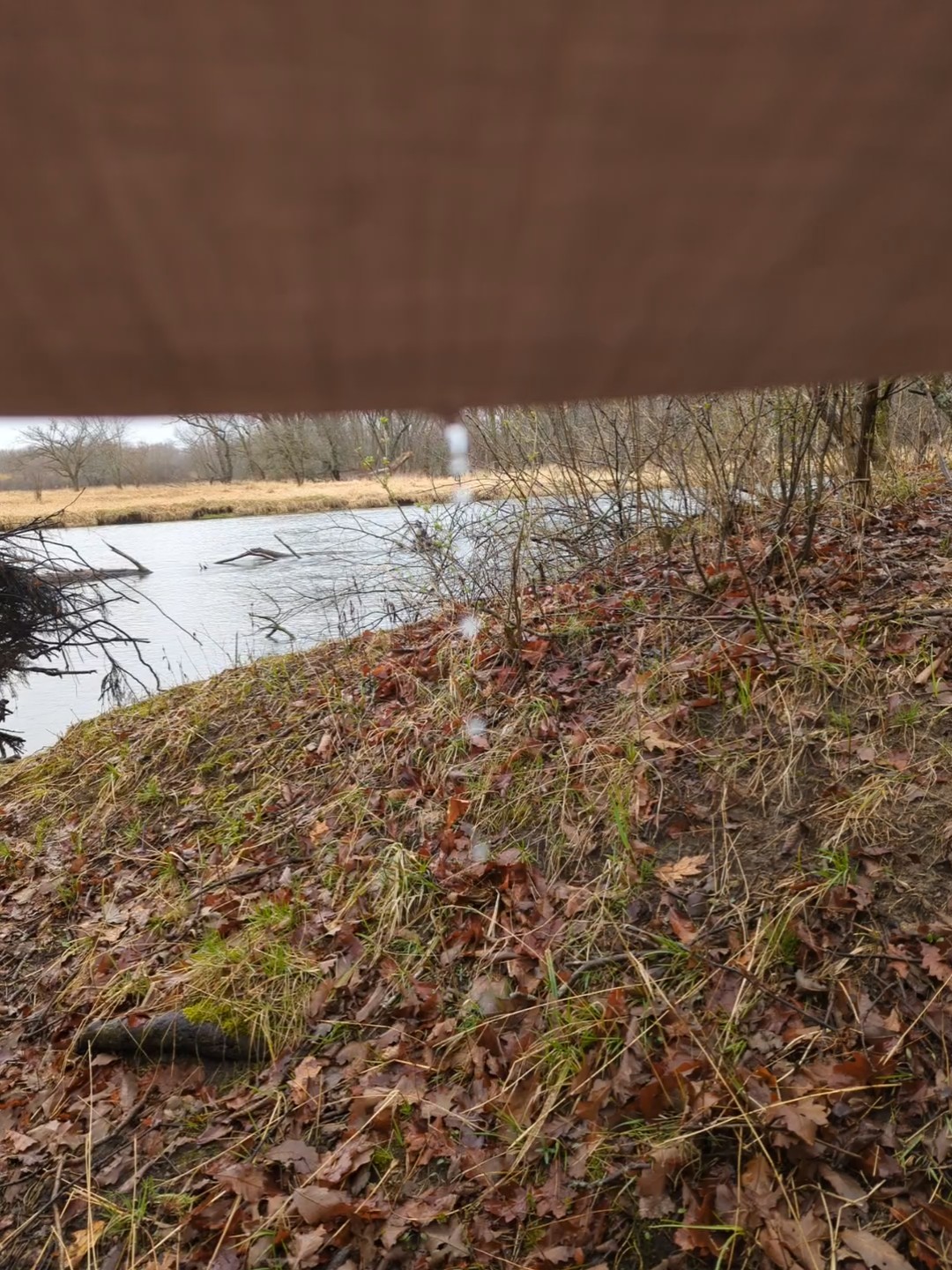
It’s Spring Break at our school this week.  So far it’s miserable weather.  It was a perfect time, however, for our dog Kora and I to head to the woods along moving water.  We hiked during an outright downpour through the woods until we met the river’s edge.  While doing so, we spooked out a barred owl from a low hanging tree limb just a mere 10 feet in front of us.  I hadn’t noticed him until he flew, as he must have held off for as long as possible to avoid flying in the rain.

I had thought of hiking into a different area, but the last time that I took Kora out she could hardly move for the next two days.  So this time I chose a shorter route that was still worth the effort.  We shared the food that I cooked over the small camp stove.  Typically I like to use a small open fire, but I wanted to go stealthy this time, plus everything in the woods is absolutely soaked right now.  Sledging in dry firewood seemed unnecessary, so I pulled out the little stove instead and it worked perfectly.

Kora’s tucked in beside me now on the quilted blanket I put down over the damp ground.  I pulled a corner of it around and on top of her because she was shaking after getting soaked.  She’s warming up now though, and actively watching and sniffing everything around us.  She’s my eyes while I journal.
CLICK BELOW FOR A VIDEO OF
ME JOURNALING AT THE RIVER'S EDGE:

Perhaps the soreness she had felt after last week’s hike was due to the terrain, and the fact that we haven’t been out for a while, although that’s never stopped her before - ever.  Perhaps it was because she’s getting a little older (she’s almost 10 years old), but she’s the picture of consistency when it comes to “getting out of Dodge” and going on an adventure.  Maybe it was due to the Lyme Disease she had as a puppy; now affecting her joints all of these years later.  I’m secretly hoping that this is not the cause, because otherwise, it could be like looking in a mirror.

I myself was just diagnosed last week with Lyme Disease.  Who knows when or where I got it.  The “how” comes from the deer tick, but I don’t really recall when I’ve had one on me; apparently I have though.  Kora had to have a series of treatments to deal with the effects of the disease.  I’m not sure what the ramifications of the disease will be for me.  It was only a week and a half ago when my wrist, ankles, knees, and shoulders began to ache and swell.  I went to the doctor a few days later for some blood work and now it’s a waiting game to see when I can get into a rheumatologist to figure it out.  No wonder it felt like I was slogging through mud when I had tried running two days in a row last weekend.  All I know at this point is that I, “didn’t get it recently”; which I’m taking to mean that I’ve apparently had it for a while.  These are some of the things I’m mulling around in my brain and thinking about while out in the woods today.

In the meantime, a mallard duck flew low along the river’s surface a while back and an eagle flew with the currents of air out over the opposite bank.  Two woods ducks cruised in squawking their “oo-week” call on the bend of the river just down from me.  I’m not sure where they went, but if they swam upstream next to Kora and me, they had no idea we were here hidden up on this bank.  The air is starting to get cooler as they predicted, and the breeze is picking up now that the rain has stopped.  It’s gearing up to reach 20+ miles per hour by this afternoon.  I rather liked the sound of the drops on the tarp I had strung up to protect us, but the wind traveling through the treetops is just as comforting.  Cardinals are calling from the large oaks around me while flickers and kingfishers announce their presence nearby.  Sandhill cranes rattle their sound as gray clouds race away to the east-northeast.  It’s what I guess Winnie The Pooh would call a “blustery day.”

I probably had some other chores to do this morning and I know I had some paperwork.  But I’ll vacuum, sweep, and get a couple loads of laundry in once I get home and dry; so that will at least be something.  I’ll need to get after those other things soon, but after the schedule I’ve had the last few months, I needed to get outside to reset.  Smelling damp, decaying leaves, seeing high moving water after almost 24 hours of heavy rain, and listening to the train engine roar of the wind through the rattling branches is well worth the cold beginning to sink into my hands and creep down through the layers into my inner core.

This outing will be the fuel to spur me forward as I finish out this school year.  A host of things have already been accomplished since last fall, but I still have some other things to rock out between now and this spring.

Virginia Bluebells Beginning To Emerge

A few weeks ago I had thought of canoeing and camping as I’ve done the last couple of years over Spring Break, but the weather this year would have been “tough sledding” - quite literally those first couple of days when we were covered with a layer of snow.  As it turned out, this outing is just what Kora and I needed.  Hiking in and setting up a base camp was doable and necessary for a day like today, and yet not so much work that when the time comes to pack it up that I can easily get it all down, onto my back, and trudge it in my pack to the old Silver Jeep.

To anyone else, today is a terrible day.  The skies are dark, the woods are drab of color, and the weather is gloomy.  It’s the kind of day that guarantees that you’ll have the forest and riverside all to yourself.  It’s what makes it a perfectly miserable day.

See you along The Way…

Kora - My Partner For Adventures!

Friday, December 1, 2023

While Golden Shadows Dance


The flames snap while golden shadows dance;
off hardwood floors and walls of rustic adornment.
As burning logs shift, sparks explode;
mini fireworks cascade into glowing embers.
Smoke drifts through the chimney flue;
evening air the ambiance of a Northwoods campground.
A snowy tread blankets frozen turf;
warm sounds of a crackling John Denver record.
“Lie there by the fire and watch the evening tire;”
while stories and visions decide to hang around like cordwood stacked against the spruce out back.
I dream of life, the world of fish, teaching, and my old bike;
documenting words struggle to leap from my pencil’s tip.
Soon enough sentences will escape and take shape I’m sure;
while time flits and flutters away at Mach speed - hurtling faster than sound and my comfort.
It’s hard to hang on if not for family, friends, laughter, and interludes;
watching flames snap while golden shadows dance.
     See you along The Way…

Thursday, June 30, 2022

Solo Canoe Trip - Wonders Encountered


“It’s always better to embark on a wilderness canoe trip without expectations and enjoy the wonders as they’re encountered.”
(Keane, Leo. “Hiking With A Canoe.” The Boundary Waters Journal, Fall 2021, p. 58.)


I didn’t have many preconceived ideas or notions going into this week’s adventure.  I did want to feel the pull of the current against my paddle, pitch my tent on a riverside bank, and do a little fishing in some deep bends and pools.  Those seemed like simple enough goals; easily achieved given adequate time within a proper setting; tasks that would allow me the opportunity to wonder at the experiences and things around me.  The fact that I experienced a plethora of wildlife and caught my biggest northern pike ever, didn’t do anything to diminish the journey.

I began the excursion Sunday afternoon once I had loaded all of my gear and lashed it down in the front of my aluminum Starcraft canoe.  It’s a beast of a thing, but it’s what I have, and as I’ve mentioned before, my Dad found it for me at a garage sale for ten bucks.  It’s been worth every cent of the investment, and I’m familiar with how to handle it in moving water despite the fact that it’s fifteen feet long and weighs one hundred pounds.

After floating out from the bank, I paddled the curving bends, occasionally stopping to fish any slower currents off the main channel.  I did have a few strong strikes, but failed to make the connection needed to see what kind of a fish it was exactly.  I reached my destination spot by 8:00 in the evening.  I made a few last casts at that point, catching and releasing both a 24” and 25” pike.  They were good looking, strong fish, and it was fun to see them scoot back into the depths of the water.

My First Pike Of The Trip - A 24" That I Released


That gave me little more than an hour to set up my tent and heat up a can of beef stew.  To prepare dinner I used a small camp stove set up on the bottom side of the canoe that I had dragged and lurched up from the river; not an easy task by myself.  I ate an apple while I waited for it to warm up.  With the excess space provided by my canoe, I had the luxury of bringing along a camp chair, and I used it while I ate to watch the sun’s last rays sink into the horizon.  I quickly cleaned off the plates down in the sand and moving water and placed my small cooler of food up under the canoe in lieu of hanging anything from a tree and away from varmints.  For one, most of the nearby trees were entangled in poison ivy.  Secondly it would take a fairly powerful raccoon to offset the canoe.  And third, since I’d forgotten my headlamp, Mother Nature was dictating when and what I’d be doing with any available light, and at that time I had none, so shoving it under the aluminum Starcraft was the next best thing.

I didn’t sleep great even with temps dipping down into the 50’s because I couldn’t get comfortable still covered in sunscreen.  Then there were the barred owls directly above me with their muffled hoots and raucous cackling that they are wont to do.  Two different deer came up behind my tent through the grass and announced their displeasure with whistling snorts and hoof stomping, not to mention the wide array of birds that began staking out their territories at first light.  In addition, a murder of crows literally pestered a pair of red tailed hawks and it’s fledgling for over an hour.  It was a perfect night to lay in the tent and take in all of the wonders.

CLICK BELOW FOR A VIDEO OF THE THE BATTLE BETWEEN CROWS & HAWKS:

CLICK BELOW FOR A VIDEO OF THE MORNING BIRDS:

To watch the videos you may need to change the "view version"
at the bottom of the page.
I started Monday by reading.  It helped set the tone.  When I came out, the birds continued their ensemble, now to the steady breeze that was quickly pushing the fog off the water and drying the heavy dew.  I grabbed my pole, attached a silver Red Eye spoon I had brought from my father-in-law’s tackle box, and headed for the river.  On my third cast I hooked into a 26” pike.  It wasn’t a strong hit, but it didn’t leave any doubt as to what it was.  I elected to keep this one fish, and set about cleaning it on a nearby log that was under the shade of surrounding trees.

Breakfast & Dinner - A 26" Pike

A campfire felt obtrusive, and too warm, so I again used the small camp stove.  I cooked half of the pike for breakfast in my cast iron skillet after coating the meat in Original Shore Lunch breading mix.  My mouth watered, and it tasted delicious.  I carefully placed the second slab of pike under the remaining ice in my cooler for dinner in the evening.
The afternoon was spent relaxing and doing various things around my camp.  While my tent was in the sun, I set up my chair in the shallows of the water and read from a book that I’d bought back in the fall from a cool little bookstore in Waco, Texas where my daughter lives, called Fabled Bookshop and Cafe, and the book was entitled, John Muir: Wilderness Essays.  I read for two hours, watching the minnows at my toes as well as other wonders of wildlife surrounding me. 

When I read, I often underline quotes that resonate with me.  In Muir’s selection entitled, “Discovery at Glacier Bay,” I like how he described his journey by saying, “though hardships were encountered, and a few dangers, the wild wonderland made compensation beyond our most extravagant hopes.”  Here!  Here!  While my camping trip would probably be termed mild in comparison to Muir’s trip to Alaska, I was still out by myself - on a solo mission far from others, and so I worked hard at taking precautions and thinking ahead to avoid having too many unexpected catastrophes.  For instance, I always wear my life preserver when I’m in the canoe and I try to have a sixth sense awareness in order to keep track of my surroundings.  With these safeguards in place at the forefront, it allowed me to appreciate everything from the large eagle perched and watching over me, to the red, parasitic mites on a harvestman spider (daddy long legs).

An Eagle Outside Of My Tent That Morning

A Harvestman Spider With Mites
When I needed a break from reading, I tried fishing again; this time using a Scum Frog surface lure.  The sun was high, and I had two smaller pike nudge at it from behind, and then one very large pike between 30 and 40 inches swung by, pushing water just a few feet from where I was standing.  Obviously they weren’t interested in the lure, but I smiled and backed off.  I continued reading, now next to my tent in the shade, until I finished the first chapter in my book.  It felt good to get back into reading again, and the setting didn’t hurt either!
I knew that if I was going to sleep that evening I needed to rinse off the day’s sweat and sunscreen, so I went over to a different section of the river that was a bit more sandy, and submerged myself by doing a push up.  It allows you to do what you need to do without going out deep.  Afterwards I took pictures of a few birds around my campsite.  When the shade was finally over the pool in the river, I grabbed my net, pole, walking stick, and backpack of fishing equipment and ventured down off the bank.

A White-Breasted Nuthatch
Peeking From Behind A Branch
An Eastern Wood Pewee

To begin with, I tried what’s called a Whopper Plopper.  It’s also a surface lure that gurgles along on the top of the water.  I did catch a nice 24” pike that exploded on it and jumped several times.  It was a nice looking fish that zipped out of my hands upon its release. 
A 24" Pike Caught & Released Using
The Top Water Lure: "Whopper Plopper"
Knowing it worked, I switched back to the silver spoon I had used that morning after retying a fresh fluorocarbon tippet onto the braided line.  On my next cast, I caught a smaller 20” pike that had a large wound across its back where something big had bit it.  I let it slip back down into the water after unhooking the lure.  I cast several more times before I had a sudden and powerful hit.  It never showed itself on the initial strike, but the upheaval of water that pushed to the surface when it turned sharply back into the depths, created a large mound of churning water.  I held on tight.  Even with the lure lodged in its mouth down below, there was no doubt who was in charge.  Power like that in a big pike is impressive if not downright spooky and humbling.
It made several different runs, dragging line with it each time, and surfaced more than once too; dancing on its reddish fins.  As the pike tired, it came closer to my legs in the shallow water; its great tail measuring cadence back and forth all the while sizing me up with its eyes.
The next few moments were a bit of a blur.  With one hand, I plunged my walking stick down into the mud, pulled out a mini bungee cord, and strapped my phone to it while adjusting the setting to a 10 second timer.  I planned to get a selfie picture of this fish.
Next I used my net, scooped up the fish, grabbed my multi-tool and tried extracting two of the three large barbs from the treble hook that was just inside its mouth - next to the teeth that were about the same size.  I had a bit of trouble getting a hold of them, so I reached down, released the bail on my reel to give my line some slack, and carefully grabbed the pike by its jaw.  I’ve seen it done before, studied how it’s performed, but had only once before tried to hold a fish this way.  Teeth, barbs on the hook, and unbridled power have a way of making you tentative.  But I wanted to try to do it right instead of always having to use a gripper.
The pike was a picture of patience, eyeing me the whole time.  As I now held it by the jaw in one hand, I grabbed a hold of each barb with the tool in the other hand and actually had to break two of them off the lure itself before it came easily out of its mouth.  There was no blood, and there was hardly a mark on the pike.  I measured it against my pole, hit the button on my phone, and posed for one picture.  However it turned out, it would have to do - hopefully capturing the moment!
I waded out to shin deep in the river, lowered the pike, moved it back and forth once or twice to work water through its gills, and then with a monstrous flick of its tail, it swung and pushed off; not out into deeper water, but it actually doubled back between my ankles and the shoreline, pushing a wave up over my gear and dousing it.  From there it simply, and slowly, finned back into the pool and out of sight.  It was as if the giant fish was saying, “Thank you for being gentle and working quickly, but take that!”  It was my biggest pike ever at 35”; two inches shy of the next eyelet, and five inches beyond the last measured mark of fingernail polish on my pole.  I was elated!  It was enough!

I cooked up the second half of my morning’s fish for dinner that evening and was in my tent and sleeping bag by 9:00.  After reading a few pages of the next chapter in my book, by the sun’s final light, I grew tired and was asleep by 9:30.  What a day it had been.
On Tuesday morning I waited as long as I could to pack because of the heavy dew covering everything, compiled with the lack of a breeze to help dry things out.  I started packing around 8:00 and had everything ready by 10:00.  I had to skip breakfast as I needed every minute to paddle the several miles to where my wife agreed to pick me up at noon.  I took a long swig of water, bit off a chunk of cheese, and set forth.
Maneuvering around hidden logs, rollers, sweepers, and any amount of dead-falls was a perfect way to end my river expedition.  I was dog tired as I pulled the canoe up on the bank a few minutes before 12:00, but it was an exhaustion born of adventure.  What had started out as a trip without a specific schedule, led to the wonders of life and its unexpected experiences.
See you along The Way…


“Why do I go?  Because the wilderness reminds me of my place in the world, points me to one who is greater, and in the end, recharges my batteries.”

(Wilson, David. “Why I Go.” The Boundary Waters Journal, Winter 2021, p. 83.)


PICTURES OF THE WONDERS I ENCOUNTERED:
A Common Snapping Turtle
That I Scooped Up With My Net
A Northern Water Snake
Eaglets In Their Nest
A Green Heron
With A Call Like A Velociraptor
A Tree Hugging Tree
Modeled After The Model
Minus The Fire   : )
The End Of An Adventure