Heavily laden the boughs were with snow; and such a snow—storybook, fairy tale, picturesque snow. The kind of snow that is compiled of layers built with each new flurry and storm. Adolescent trees bowed in humble submission under its weight, biding time until sunlight, wind, or mild temperatures set them free to spring upright and continue their journey to the sun. A quest that would not resume for another five to six months.
The depth of snow varied depending on where I hiked and plunged the end of my walking stick. The greatest measure was in areas of hardwoods where it had fallen from cold leaden skies through bare branches void of life and leaves—a good foot to foot and a half deep. Vitals of the deciduous dicotyledons were now shelved and stored in each tree’s pantry of roots deep below the frost line; liquid sugar energy biding its time.
Snow below the coniferous trees was not quite as deep, with the snowfall accumulation trapped on the needled branches the difference between the totals. It’s a concept referred to as snow interception—when the snow builds over the canopy of the forest. Each tree has a specific carrying capacity upon the exposed surface area. The entire process is significant to the distribution of water within an ecosystem; some falling down and melting into the soil, some melting down the tree and into the roots of the surrounding plants, some nourishing moss and lichens living symbiotically on the tree’s bark, and some sublimating directly from a solid to a gas and adding to the humidity of the surrounding air.
They say the people of the Inuit culture within the Arctic regions of North America have over fifty different words for the various kinds of snow. Oh to know and speak even half that number! Limitations of speech, dialect, and knowledge are often an anchor. Imagine the descriptive richness of being able to acutely depict the snow through which you trudge with a distinct word based on the temperature, age, and percentage of water content.
The snow I trudged through had already chewed me up and spat me out while driving north—when an approaching storm’s presealant mist rendered my tires useless and threw me into the ditch of a divided highway’s median. Saying I was scared in that brief moment probably belittles the situation, but flying sideways at over 65 miles per hour in deep snow has a way of plunging icy cold fingers of uncertainty deep into your chest and clutching your still beating heart. Fortunately I didn’t hit anything and stopped in such a position that with four wheel drive, weight on the rear axle, scientific ingenuity, and pure dumb luck I somehow managed to work my way out of the potentially adventure ending predicament—albeit now in the second lane of the sparse southbound traffic. I soon found a place to turn around, however, and after cautiously driving through Rhinelander and Eagle River, Wisconsin, I crossed the border into Michigan. Nine miles later I arrived in Watersmeet and drove up to the Ottawa National Forest Visitor’s Center on the hilltop overlooking the town. There I met up with Karl and Forest; two rangers who work the information desk. The dynamic duo became my lifeline before I headed into the unknown. Karl had guided me towards a great spot to camp and fish last spring, and this time as tag team partners they explained options for heading into the Sylvania Wilderness Area. Forest had some additional insight as a YouTuber who often camps along the lakes of Sylvania and posts videos of his adventures under the name "Hemlocks & Loons." Talking and planning with the guys helped ease any anxiousness I had for heading out on my own for the following two nights.


Once I had come up with a plan, I drove west to the Sylvania Entrance Center. The sign-in logbook, stored under the lid of a perfectly constructed wooden box, had well over a foot of snow piled on top of it. I cleared it off with my hand. Apparently it had been a while since anyone had camped within the more than 18,000 acre wilderness area. The last person to record that they had gone camping was five weeks prior during the first week of November. As it was the second week of December, and lightly snowing, I hustled to the trailhead and began to gather gear that needed to be lashed into my sled. With the snow deep, and being the first one to trek through that section of the woods in a long while, I had brought along my favorite snowshoes. My parents gave them to me for Christmas over 35 years ago. Constructed of classic wood and rawhide, they would help me navigate the several miles to my campsite of choice. While many styles of snowshoes exist, I liked the design of the pair I had brought—both for their wide base and relative length. They are adequately known as either Huron or Michigan style snowshoes. More importantly, they would keep me from sinking too deep and yet allow me the agility to traipse around trees and brush.


Although difficult to identify one hundred percent, I found myself following the prints of a bounding wolf. In fact, I was pretty sure that I was pushing it in front of me by my mere presence. At times there would be almost ten feet of space between the fresh set of tracks as it worked to stay ahead of me. The tracks showed no belly marks which indicated that it was long legged and would duck under low hanging trees showing its dexterity. While following the wolf was exhilarating, 300 year old fairy tales had me periodically checking over my shoulder to make sure I wasn’t being followed.


I also saw the tracks and scat of a rather large weasel that must have been a fisher. It’s an animal that is large, seclusive within dense forests, and is one of the only predators able to kill and eat a porcupine. While working to hike and pull my sled of gear along the ancient roadbed and through the deep snow, I felt fortunate to have encountered the signs of those Northwood mammals.
The sun set a little after 4:00 that evening although under the heavy cloud cover there was little indication that it had even happened. After nearly two hours of snowshoeing into an unfamiliar area I finally located the camp’s lakeside marker-post positioned as such for mild temperature canoeists. At that point the time was 4:45 and I found myself slightly whipped, sweaty, and with my only visibility the result of reflections off the snow. It wasn’t a great way to start assembling my camp, with the temperatures about to bottom out, but I made the most of it—hoping that as I slowed down and went to work that I’d cool down and my inner layers would dry.

I used my snowshoes to tromp and pack a circular area large enough to hold the footprint of my tent. After it was pitched, I threw in my bedding and zipped it closed to keep falling snow from sifting through the fine mesh screen. With a headlamp strapped over my fleece beanie I began making trails throughout the ridge behind camp in search of dead dry firewood. It was a chore that was to become seemingly nonstop in the quest to cook food, melt snow to heat water, and stay relatively warm. Within the surrounding forest I mostly found balsam, a few spruce, and some fallen hemlock branches. It was cool to look back and see the wide snowshoe trails I had created crisscrossing amongst the tree trunks. It reminded me of the curvy paths I would shovel as a young boy for my sisters and I to run through in the deep snow of our yard. Back then it created a sense of exploration within the shadow of our house.
After a dinner of a pork chop and blended rice, I packed an aluminum pot with snow to melt and boil for a hot water bottle I had recently bought. With a couple of cold weather camps under my belt, I was bound and determined to get it right and tip the scales towards thriving over simply surviving. The memory of frozen toes being my ultimate motivator. Sleeping on a snowpack and without a specifically designed winter tent and wood stove I had to think and plan ahead.
In the tent I spread out the first of my wool blankets. Next came the accordion switchback mat, the inflatable insulated mat, my down sleeping bag with a recently purchased fleece liner, topped off with another wool blanket. As I crawled into that nest, I peeled off my outer layer and crammed my coat and pants down into the end of my sleeping bag. I kept on my fleece base layer but added dry wool socks with stick-on heat pads applied to the forefoot. Lastly I pulled on a fresh stocking hat and down booties. The hot water bottle I positioned against my back. I still woke every 2 to 3 hours, but I slept. Indeed, I slept and managed to stay warm!

The following day, my one full day in Sylvania, started early enough with the 7:30 sun rising on the southeastern horizon deep behind the gray overcast stratus clouds. Outside of my tent I thoroughly enjoyed being able to see all of my surroundings while getting my bearings in the dim light around the campsite.
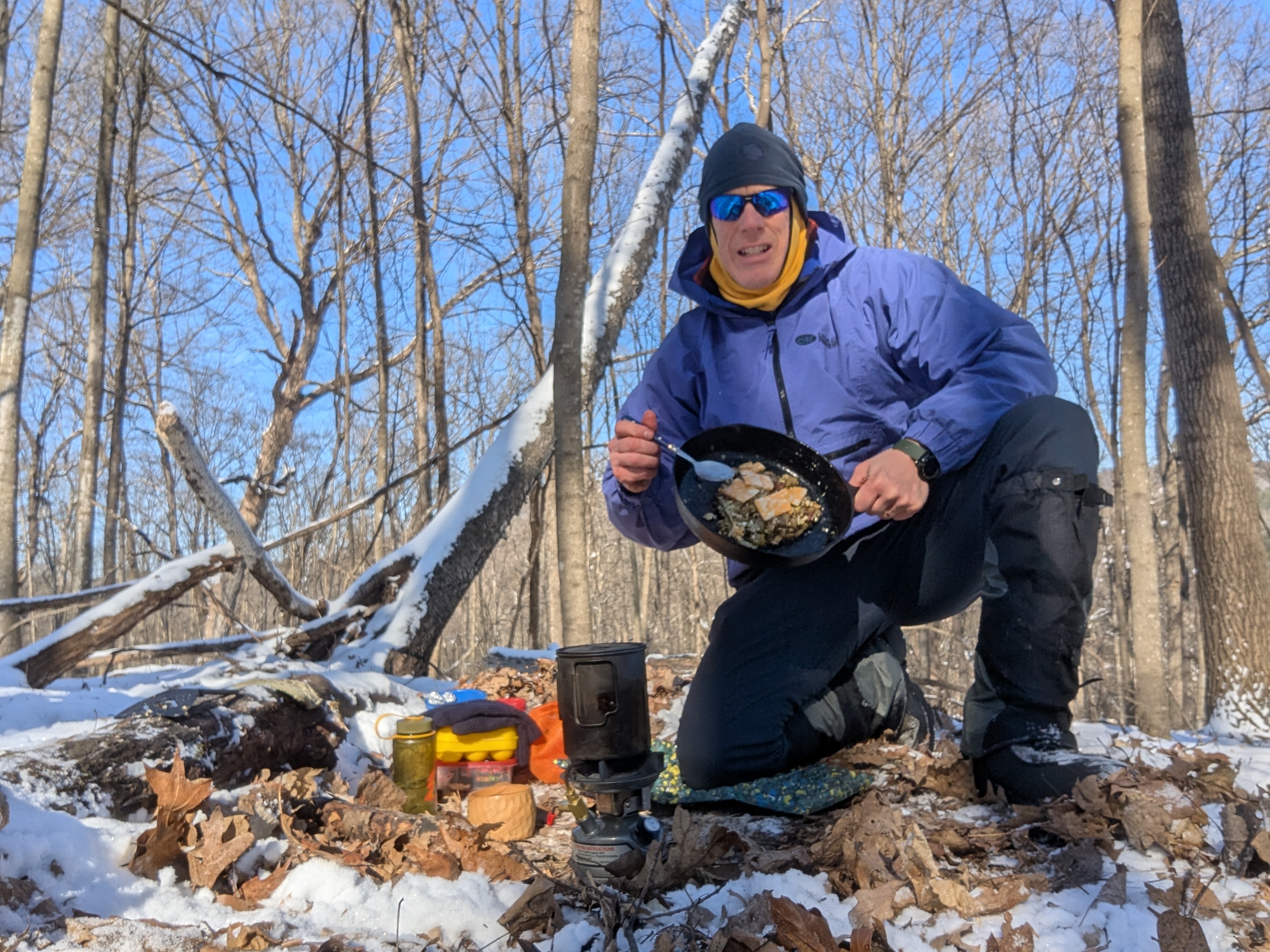
I was camped beside Clark Lake on the site named Pine#2. The expanse of the snow covered ice out on the lake was vast, and I half expected—even hoped—to see a wolf pack racing across it to some remote gathering point; a howling rendezvous. But it remained barren other than a set of unknown tracks circumnavigating the lakeshore. The name of the lake itself seemed a good omen of things to come, as the original homestead on my Dad’s side of the family sits on the shore of a lake by that same name in the lower peninsula of Michigan. Five, and soon to be six, generations of my family have dipped their toes in its waters or stood on its ice. The fact that I was 550 miles away from that lake and standing all alone in Sylvania didn’t go unnoted. I took a few pictures to capture the moment before cutting more wood to cook a classic breakfast skillet.
Once I had cleaned up and organized my cooking gear, I decided to take a day hike towards some campsites further up along the lake. I was looking forward to walking under the giant hemlock trees that lined the shore. Outside of my bedroom window when I was growing up, was a massive hemlock tree. I liked to imagine that it had somehow survived the lumbering days as a young sapling. On the west side of our house was a hill that went down into an old pond. That large hemlock grew at the base of the hill beside the seeping waters of the pond. It was one of the many sledding hills that my sisters and I used throughout the long winter months. It was steep! It was fast! A natural jump typically formed next to the hemlock as snow was pushed and packed; a jump that would launch us out onto the frozen flat beyond. I loved waking up in my bed and looking out at that hemlock. From the height of my second story bedroom window I could see directly into its crown and watch the small red squirrels scurrying up and down its trunk—to and fro their nest through a small hole in the hemlock’s trunk.
To prepare for my day hike I packed some snacks and a few “just in case” essentials into my backpack, strapped on my snowshoes, grabbed my walking stick, and headed north by northwest into the snaking hemlock grove lining Clark Lake.

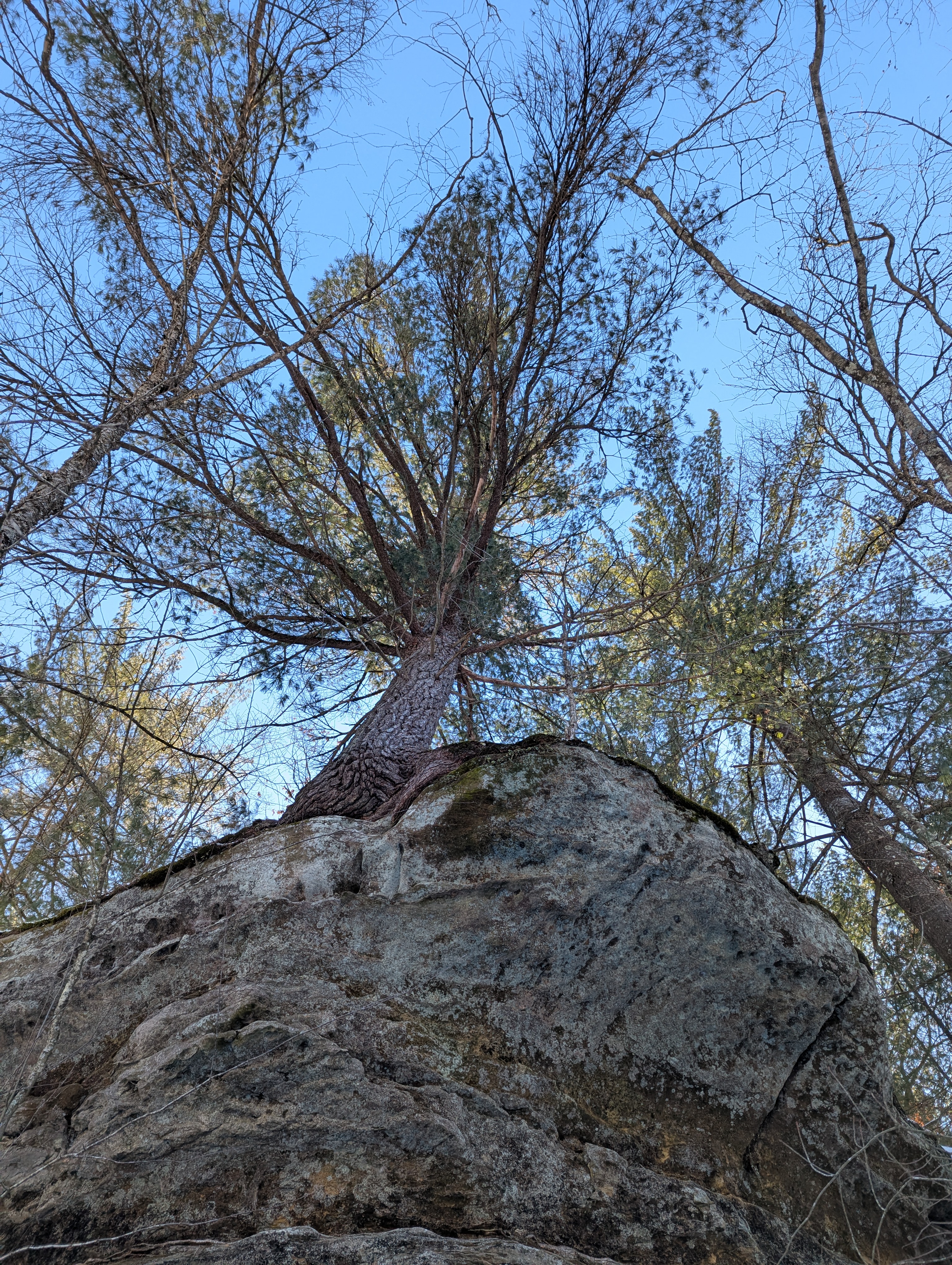
Snow fell at a moderate rate and as I trudged along I imagined where some semblance of a trail might have been under the snow cover. Along the way I enjoyed seeing the trees; identifying the giants of the various species—hemlocks, eastern white pines, yellow birch, eastern white cedar, balsam, and occasional sugar maples that made their way down off the ridge. I took pictures of the special ones. At one point I found two matching trees bent at the same angle ten feet up their trunks—looking like the marker trees that native tribes were known to use for indicating the direction of important destinations; much like an interactive map. Most likely the two trees told a story about one of the neighboring monarchs of the forest falling over onto them in such a way that they both had to bend in order to grow up and around its obtrusive trunk; now rotted and nourishing the soil of their intertwined root systems.


At each of the succeeding three campsites it became a quest to shuffle from the lakeside marker up onto the backside ridge to dig down through the snow and try to find the ensuing firepit that the U.S Forest Service requires campers to use. The iron fire ring is one of the only indications of human presence allowed in the wilderness. The Wilderness Act of 1964 defined wilderness as “an area where the earth and its community of life are untrammeled by man, where man himself is a visitor who does not remain…An area of undeveloped federal land retaining its primeval character and influence.”
On that explorative hike, I truly felt the forest’s primordial character. I was alone. No human beings were anywhere close to me at that moment—the closest was miles away; and only a few select people even knew where I was specifically camped. And yet, I was not alone. I was surrounded by those I knew; massive old growth trees, blankets of snow, steep hills, and various tracks—individual components bound together in that expanse of wilderness. Perhaps during warmer months Sylvania is a revolving door for those seeking isolation or connections; all together in relative proximity. But such a scene was not the case on that cold snowy day. I was alone with past memories, current thoughts, and the natural things around me.
As the snow fell steady and slightly heavier, I found the Pine#1, Balsam#2, and Balsam#1 campsites and fire pits—in that order. And then I found a lakeside log, cleared it off, and sat for a few minutes. It was nice to just sit. I listened to my breathing. I had been snowshoeing for an hour up and down steep embankments rising up out of the lake. I felt my heart beating. The air was crisp and the scenery was beautiful if not nostalgic.
It was at that time, while looking down the length of Clark Lake and eating a small package of trail mix, that the sun found a worn spot in the grayness and managed to send out a few of its liberated rays; unshackled sunshine in the midst of snowfall. It created what one would naturally entitle a winter wonderland!


It took me half the time to snowshoe back atop my previous trail, around appropriately named Golden Silence Lake just off the eastern shore of Clark, and back to my camp site. I had about 2 hours until the sun set, so I went out onto the point in front of my camp to view the entire south end of Clark Lake. The rich green woods lit up in sharp contrast with the blinding white snow covering the ice.

When I hiked back, I started a fire and then collected, cut, and split more wood. For dinner that night I had a Hiawatha Pasty that I had picked up in Naubinway, Michigan on one of my trips through the U.P. earlier in the fall. I triple wrapped it in aluminum foil to heat it; eating it with some ketchup an hour later. Typically when fresh, I like to eat a pasty plain, but I decided to splurge that time in celebration of an excellent day—as if beauty needed an extra condiment. The crust and ingredients warmed the cockles of my heart; enough so that after a cup full of hot chocolate I headed for bed. Though it was still early afternoon by most accounts, it was dark and had been for well over an hour. It was as if the Northland was saying, “Welcome to Winter and Good Night!”
I had several hours of hard work ahead of me the following morning in order to trek my way back out to the trailhead and still have time to stop back by the Ottawa Visitor’s Center before driving back home. Prior to lights out, I briefly journaled on the day and then read three chapters from Sigurd Olson’s book, Of Time And Place. In the chapter named, “Waiting” he wrote, “Waiting gives us a chance to realize we cannot solve the complicated puzzles of our lives without considering the vast complex series of variables that have a bearing on everything we do.” (140) And while my trip to Sylvania had been a lot of work, I also found myself waiting. It’s something I enjoy and need to do more of during those moments when opportunity meets the forefront of my mind. When considering the variables that influence and make me who I am, it’s important to be still and appreciate all life’s blessings; even while moving and working.

I was asleep by 6:45 P.M. What else was I going to do? In addition, the temperature was at 8 degrees Fahrenheit at that point! I stirred and repositioned my sleeping arrangement about every three hours. By 6:00 A.M. I was awake and ready. I laid in my coziness listening to the wind in the tree tops for a few more minutes. Clumps of snow slid off the boughs and landed around me like soft, cottony mortar shells. Twenty minutes later I got up, dressed, and packed my sleep gear. I made a fire to heat water for breakfast while I took down the tent. After eating I lashed everything to my sled and was ready to snowshoe out by 8:40. My mind set itself to a steady pace following the trail I had made two days previous. It was a pulse like a metronome that propelled me for an hour and a half as I snowshoed back to my vehicle. At one point I could see where a bobcat and later a snowshoe hare followed and then crossed my old path. My entire time in Sylvania had been swallowed by space, time, snow, and wilderness. Not once did I see an actual animal. I heard a chickadee, woodpecker, raven, and red squirrel a few times. I saw various tracks left in the snow; unique tracks. And while I was able to lean back against the broad base of an absolutely huge white pine behind my camp and feel its history and power, the animal critters were hunkered down and stayed hidden during those couple of cold winter days.

Although the trip took effort, the experience took my heart and soul; constant movement interwoven with constant reflection. It was a reflection of self, but also a reflection of memorable experiences from the past—topped off with a healthy dose of living in the moment! There is something profound about spending several days alone with your thoughts in a picturesque setting, nestled deep in the wilderness and under the snow laden boughs of the hemlocks throughout Sylvania.
See you along The Way…

I think often of the peace and wisdom of the wilderness. Wilderness is a great teacher—it has taught me to work hard and challenge myself. The backcountry has also taught me humility, but most of all it reminds me that I am connected to and inseparable from the earth and all my fellow humans. Winter camping is hard work, but what a privilege it is to just be in the wilderness and be renewed.
- Amy Fredregill: “BWCAW New Year’s Tradition.” Boundary Water Journal-Winter 2021